How to Fund a Startup – The Epic Oatmeal Hack

We have a startup. We have 7 kids. We have a mortgage and two cars like a normal family. Years ago, we decided to sacrifice many normal comforts to ensure we had enough money to fund our business until we could pay ourselves.

We now draw a salary, but decided to keep those sacrifices in place, as much as possible, as it enables us to occasionally eat out, and have some money in the bank.

One of the ways we saved money was avoiding pre-packaged food. It’s fine when you have one or two kids, but multiply that by 7 and you go broke pretty quick. I count cereal as a prepackaged food. Those boxes really don’t hold much.

We were spending about $30/week on cereal and that was when we only had 5 kids. That’s $1560 per year.

So we switched to the much healthier option of steel cut oats with fresh fruit. It costs me exactly $62.55 with tax every two months. I buy a 50 lb sack at Whole Foods.

At first, the kids absolutely loved it. A few years later, not as much. But now, Sunday is a special day. Cereal for breakfast. Belgian waffles or pancakes and bacon for brunch after church, and a yummy cup of juice.

There was also the time factor to consider. With steel cut oats, the kids get a hot breakfast, without needing me to actually cook it.

I bought an old crockpot at our local thrift store for $5. I prefer the really old crockpots because they are not lined with lead glaze.

Each night, I make the oatmeal in the crockpot and by morning, it’s ready for the kids, no matter what time they wake up.

Steel Cut Oats in the Crockpot

  1. Put one part oats to 4 parts-ish water in the crockpot
  2. If I’m feeling like a nice mom, I also take one of the leftover apples that are half eaten, peel it, and cut little chunks into the oatmeal.
  3. Add 1/2 tsp cinnamon.
  4. Turn crockpot on low.
  5. Walk away.

Sometimes I only do step one and five. Then the kids rejoice because I forgot to turn on the crockpot and they get to have cereal.

Usually, I do steps 1,2 and 5 and then we throw some fresh berries on it in the morning. Or, when cranberries are cheap, I’ll get those and stick them in the freezer. Those taste fabulous in the oatmeal when you cook them overnight, as do dried cranberries. I don’t recommend cooking bananas in there overnight. It tastes a bit gummy.

Startup Scalability Lessons Learned from the Shoe Lady | #3 Reduce Your Vertical Markets

Oooh. Shiny balls. I like chasing them much as the next gal. It’s so easy to get distracted as a mom and COO. Especially when everyone loves your MVP (Minimum Viable Product) and has great ideas of how it can be used in the market. This is the third from Startup Scalability Lessons Learned from Being a Militia Mom. This week my new title is the Shoe Lady. Not because I own more than three pairs of shoes, but because my six kids and inability to make the Forbes under 40 list qualify me for Old Woman in the Shoe status.

When we were in our accelerator in Austin, one of our advisors helped us interview a potential CMO. He described our founder team as people who are constantly chasing shiny balls and then asked the candidate, “are you capable of (a) interpreting their directions yelled over their shoulder while they’re in the chase (b) reigning them in and (c) not throwing more balls at them?”

With a startup, there’s a real danger when everyone is in love with your MVP. You do your customer discovery and discover that everyone would pay for your product… if only. Or they have a great biz dev idea for you… if only. Their if-only’s require “a few tweaks” to your messaging and website. Then there’s the extra testing in the marketplace. And the problem is that all of their ideas really are great. It’s too much.

So, here’s what I learned in my shoe closet. You really do have to reign things in and gain traction for your MVP, unless a pivot truly is necessary. In parenting terms, this is actually very easy to apply. We have six kids. If each of them were in the culturally accepted, 4 to 5 activities per kid, we would be out of our minds. Or even if one or two of them were in a travel sport requiring a commitment of 10 to 20 hours per week including travel.

When multiplying everything by 6, it’s easy to see what needs to be cut out. Playdates become impossible as few people want to house our shoe collection. Luckily they have built in playdates with friends who look eerily similar to themselves. Hmmm, that frees up more time in my schedule.

Lessons and classes that are beyond walking distance and cost more than $20/season/kid are also out of the question. Oh wait, I’m not spending time getting them ready, driving them to activities, and volunteering at the acitivities. Hmmm, this is looking good.

So, after proving out my model on my MVP, I can replicate across other platforms. In parenting terms, the younger kids have the privilege of doing whatever activities the MVP (eldest) picked out. Otherwise known as “Marcia, Marcia Marcia” syndrome. It increases efficiency both at work and home, with the side benefit that it legitimizes my kids’ claims of unfair parenting. 🙂

From the Wisdom of a Shepherdess | Startup Scalability Lesson #2: Pivot When Needed

Shhh, I came out of the mom closet last week, with 10 Startup Scalability Lessons Learned from Being a Militia Mom. For those who were offended at the thought of my own personal militia of offspring, this week I declare myself to be a shepherdess.

Stupid Mom Fear #2: I could never love another child as much as my first. In startup terms, “I could never pivot from my MVP.” In my secret life as a supermom shepherdess to my flock of 6, I learned that lesson the hard way.

I had heard several friends with one kid say they were far too in love with their first kid to ever have another. I thought it stupid, until the same fear crept over me. My MVP (or first born child) was 20 months old at the time. Unfortunately, I was also 8 months pregnant with my next kid. Didn’t say my timing was perfect.

As a parent, you pour all your love, attention, expectations, and fears into this first born kid. As a COO, you pour all your money, time, expectations, into your MVP (Minimum Viable Product). In both scenarios, you are essentially staking your worth on your first attempt. Well that’s just stupid. If Edison had done that, we’d all still be reading by gaslamp.

Our first startup was born of a hobby I had while a stay-at-home mom. I’m incapable of playdates and children’s museums. Scratch that, I’ve done them; I just don’t enjoy it. I had to do something techy with my time. So, I began to shoot and edit our home movies.

I got pretty good at it. So good, that one of our neighbors, who is a video editor, suggested I sell the service. Genius! Everyone thought so. I went to SCORE. The advisor said it was such a good idea that I needed to slap the kids in daycare and get right on it.

We invested thousands in marketing and professional equipment. I became fully certified in all the software. We had a launch party with 200 people. Everyone swore they were going to be our first customers. That was in September. Uh-oh. Christmas was coming soon. I was going to get 200 orders in the next few weeks.

Oops. Well. No. Two measly orders trickled in. For slideshows.

So we offered preservation services and invested in more pro equipment to handle slides, film, reels. More excitement. This was going to be awesome! And we did get some orders. They were very high dollar. But a few high dollar orders per year does not a startup sustain. If we wanted a mom and pop business, we were on our way. But we are not mom and pop people. Ironic.

Then we got a real, home movie order. A big one. An intricate edit culled from 21 tapes and digital files, taken over a period of years. Awesome. But the client wanted in-depth control over how the story was told in the edit. After a ton of back and forth, I had two major deadlines looming on me. He wanted this by Christmas (2 weeks) and I was in labor with our fifth kid. Literally.

[Editor’s note: remind me to tell you the story of how my co-founder accidentally delivered that fifth baby.]

I sucked it up, bought a boppy pillow, and nursed my two day old little redhead at the computer while cursing Final Cut Pro. Cursing our startup. And being a general bitter shrew.

And that’s when we learned several things about our MVP.

  1. When everyone you know LOVES your idea, it does not guarantee you’ll be the next Instagram.
  2. People were not going to pay for an edited video unless they either had an event it was commemorating or an event at which to show it.
  3. We needed some automated way to get feedback from our editing clients which reduced recuts.
  4. Nursing moms are the most brilliant people in the universe.

We pivoted. It was hard to make the decision to stop offering products that we knew we could sell. It was hard especially when the decision came at a time where my cofounder/gorgeous husband had already quit his full time job and we were pouring all our revenue back into the business. You heard right. Five kids. No income. And still we pivoted.

We folded our original LLC and launched Storymix Media Inc. Brand new MVP using new technology gleaned from lessons learned in the last one. We developed an online storyboard which would allow clients to tell us which scenes to include in their edit automatically. It saved 85% of the editing time and allowed us to drastically reduce prices. Don’t mess with a techy nursing mom. She’ll come up with some amazing code to save her sanity.

10 Tech Startup Scalability Lessons Learned from being a Militia Mom

True Confessions. I’m the full time COO of a startup. I have six kids. My friend from Austin calls it my own personal militia.

There’s a boatload of scalability lessons I’ve learned from my militia that translate to my startup. And lest anyone think my business has anything to do with estrogen, it’s a tech startup in a completely male dominated sector. I simply have the unfair advantage of being a militia mom. My competition hasn’t got a chance.

  1. Use your MVP (Minimum Viable Product) to prove out your model 
  2. Pivot when needed
  3. Gain traction in one vertical before chasing every idea thrown at you
  4. Empower your team
  5. Design your platform with scalability in mind
  6. Timing is everything
  7. You will occasionally get peed on
  8. Optimize your expenses
  9. Get into a good incubator
  10. Be the Boss

For now, I’ll touch on MVP – or as I called him, my firstborn child. We used our MVP to prove out our parenting methods. Little did we know that this perfectly awesome child had less to do with our parenting methods and more to do with the grace of God. This will of course bring us to the point about pivoting. For our MVP parenting method, we went with the sage advice of a friend, “Treat your first like he’s your third and you’ll be just fine.”

In business terms, the MVP allows you to go to market with an idea, perhaps tangible, that you can test in the market. The important question is not whether anyone wants or likes your product. Who cares? You need to know whether they will actually pay enough for your product to make it worthwhile. Our startup’s MVP has been called one of the most ugly landing pages ever created. And yet… we had people begging to buy our product before it even existed. Not a bad start.

In parenting terms, taking your MVP to a fancy restaurant proves out whether your parenting sucks or you need to pivot. If the waiter offers you dessert right after the appetizer if you’ll simply leave, your method sucked, you’ve raised a tyrant and it’s time to pivot. If kids in the neighborhood are undercutting each other’s babysitting rates for the privilege of watching your child, we have a winner.

The Power of #FAIL | The Etiquette of Using Twitter for Customer Service

Here’s a tale of two twitter conversations: one a success; one a failure. As a business, you do want your clients to tweet about you. Sometimes it will be good, but not always. Publicly addressing the negative comments can be a big public relations win. Blowing it can make you look like a moron.

Just so we’re on the same page, for the newbies: “@” means you are talking to someone directly on twitter, kind of like you texted them, except that it’s public. A hashtag (#) indicates a trending conversation. #FAIL is the hashtag used for “dude, you blew it big time and I’m ticked off”.

Dissection of a #FAIL

Let’s take a look at my friend Sharon’s conversation with her friend on Twitter:

#fail customer service

Takeaways:

  1. Don’t butt in on someone else’s conversation. Sharon didn’t type @VirginMobile. She wasn’t asking for help. She was simply venting.
  2. If you are going to ignore rule #1, be helpful. What good was the social media team going to be in a signal strength issue? They should have connected her with tech support.

Dissection of a #WIN

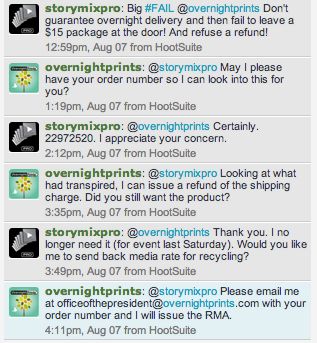
A little background. I spent four hours creating custom designed bookmarks for a party we sponsored in New York City on August 4th. The party was for Boombox Network at BlogHer12. Gotta give them a shoutout! The design was completed and uploaded to Overnight Prints on July 31st. I needed them shipped overnight to NYC.

I placed the order by phone, to ensure I could get my marketing collateral in New York by lunch on Friday. Although Overnight Prints shipped Thursday night, the UPS driver deemed Astoria, Queens too unsafe to leave the $15 package. So it was delivered 2 days after the party. If you’ve ever been to Astoria, you’ll know that is absolutely ridiculous.

So, here is the dilemma. They did print and ship on time. But I, the client, did not receive my merchandise on time for my event; rendering the bookmarks useless. The salesperson at Overnight Prints failed to mention that overnight delivery is only guaranteed if someone is there to receive the package.

First, I emailed customer service. They refused to do anything. Then I called. The first representative refused to help. The supervisor also refused to help. Only then did I tweet the situation.

customer service #fail twitter

Takeaways from a business standpoint:

  1. Acknowledge that there is an issue. Overnight Prints immediately researched the case. They didn’t offer any platitudes about “feeling my pain”. They looked into it.
  2. Try to take the conversation offline. The actual resolution was handled through email. This is preferable when there are private details involved.

Takeaways from a consumer standpoint:

  1. Twitter is the fastest way to give and receive customer service. I tweeted at 12:59 pm, they addressed the issue at 1:19. I didn’t have to wait on hold on the phone.
  2. Follow expected customer service channels first. It would have been unfair for me to publicly flog them without giving them a chance to rectify the situation privately.
  3. Be courteous. Just because twitter is anonymous, that does not give you the right to be abusive. Ever.
  4. Be realistic. They did print the merchandise. They did ship it on time. I never expected a full refund. I didn’t receive one, and yet I’m still totally satisfied.
  5. Look at 3 and 4 again. Even if you don’t get the outcome you hoped for. Let it go. Go have a beer. But do not be abusive to customer service people.

And here is our conversation later that day:

Some day your business is going to encounter an unhappy customer. I guarantee it. How you handle that situation publicly can make you look like wonderful. Just try not to look like a twidiot.